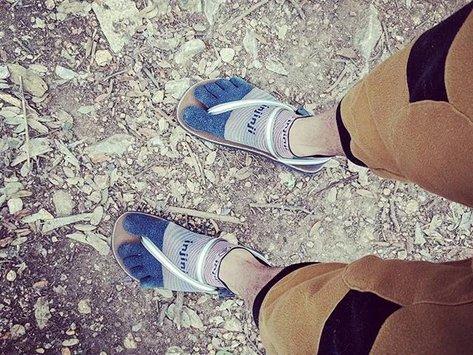
Is the Huarache Sandal Really the Best Shoe of All Time? Here's the Case For It
Sandals get filed under fashion or casual wear in most of the Western world. That undersells what a properly built huarache — the traditional footwear of the Tarahumara — can actually do. This isn't a claim that it's the only shoe worth owning. It's an argument for why it deserves a serious look, based on what the foot actually needs to function well.
The most common pushback: "But do they stay on your feet?" Yes — a correctly fitted huarache-style sandal stays firmly attached without the foot doing extra work to hold it on. That distinction matters more than it sounds.
Not All "Minimal" Footwear Is Equal
A lot of shoes get lumped into the "minimal" category simply because there's not much material there. Flip-flops and other loose-fitting sandals don't qualify. Because they aren't secured to the foot, the toe flexors have to work overtime just to keep them on — and that extra, unnecessary muscle activity interrupts the foot's normal firing sequence and changes movement mechanics in ways that aren't helpful.
The Pronation Question
A common finding in clinical practice is poor control of pronation and supination — poor control of the arch, in plain terms. Most people have absorbed the idea that "pronation is bad." That's not quite right. Pronation is a normal, necessary part of the gait cycle, and a large prospective study of nearly 1,000 runners found that the amount of pronation itself wasn't what predicted injury [1]. What matters more is how well that motion is controlled through the gait cycle — not how much of it happens.
Worth noting: research in higher-impact, multidirectional sports like basketball and volleyball has found a relationship between excessive, uncontrolled pronation and injury risk in those settings. That's not a contradiction — it's consistent with the same idea. The problem was never pronation itself; it's when the foot can't control or stabilize through that motion, especially under load. A rigid, structured shoe doesn't teach the foot to control anything. It just prevents the motion from happening in the shoe — which isn't the same thing as building the capacity to control it.
Does the Arch Actually Need Support?
Huaraches have no arch support, which raises the obvious question: doesn't the foot need it? Generally, no — not as a permanent fixture, the way it's typically prescribed.
A foot that's been loaded and challenged consistently over years doesn't need external support to function well. The problem is that most feet haven't had that chance. Years in a narrow toe box interrupt the foot's natural stability system. Any amount of heel lift shortens the heel cord over time and shifts posture up the chain. Restrictive, structured footwear is the norm for most people, more than most realize — and that has weakened the foot's own capacity to do its job.
Barefoot and minimally shod populations show markedly lower rates of running-related injury than shod populations, and part of the proposed mechanism is that the unsupported foot develops the ability to absorb load through the arch itself, rather than relying on rigid structure to do it [2]. There's also a proprioceptive piece: foot position awareness is more precise barefoot than in structured athletic footwear, and reduced awareness of foot position is considered a meaningful contributor to ankle sprain risk [3].
Rebuilding What Was Lost
One of the more effective ways to rebuild the foot's natural strength and control is progressive barefoot exposure. That's a real transition, not a quick swap — and it's worth being honest about the timeline. Shifting to minimal footwear without injury generally takes patience: months of gradual loading at minimum, and for most people who've spent decades in structured shoes, more realistically one to three years to fully adapt, longer still to resolve tissue restrictions that built up over that time. That range reflects clinical experience working with deconditioned feet, erring toward the conservative end — not a settled number in the literature, since individual adaptation timelines vary widely and haven't been rigorously studied as a single outcome.
Even with a careful transition, there's no guarantee of zero injury risk along the way. That uncertainty is worth naming rather than glossing over.
Is It Worth It?
That's a fair question, and the honest answer is that it depends on what you're solving for. What can be said with more confidence: the strength, mobility, and control that come from progressively challenging bare feet are a legitimate clinical target, not a fad — and they're worth pursuing deliberately, with the right guidance, rather than diving in unprepared.
Feet were built with an extraordinary amount of capability already designed in — capability most modern footwear quietly overrides rather than supports. Recovering that capability, patiently and correctly, tends to pay off for the athletes and active adults who put in the work.
Want to know if a transition to minimal footwear makes sense for you, and what a safe path there actually looks like?
References
[1] Nielsen RO, Buist I, Parner ET, Nohr EA, Sørensen H, Lind M, Rasmussen S. Foot pronation is not associated with increased injury risk in novice runners wearing a neutral shoe: a 1-year prospective cohort study. Br J Sports Med. 2014;48(6):440-447. https://pubmed.ncbi.nlm.nih.gov/23766439/
[2] Robbins SE, Hanna AM. Running-related injury prevention through barefoot adaptations. Med Sci Sports Exerc. 1987;19(2):148-156. https://pubmed.ncbi.nlm.nih.gov/2883551/
[3] Robbins S, Waked E, Rappel R. Ankle taping improves proprioception before and after exercise in young men. Br J Sports Med. 1995;29(4):242-247. https://pubmed.ncbi.nlm.nih.gov/8808533/
