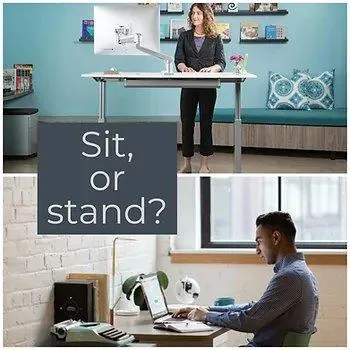
Butt in an Ashtray, Foot in a Coffin? Why Your Standing Desk Isn't the Fix
You've probably heard that sitting is the new smoking. So you bought the standing desk, felt good about it for a few weeks, and then noticed something: your low back still hurts. Your knees still ache by 3pm. Nothing actually changed except what position the discomfort shows up in.
That's not a failure of willpower. It's a sign the whole premise was incomplete.
The Real Math on Standing
Standing does burn more energy than sitting — about 0.15 kcal more per minute [1]. Over a year, swapping six hours of sitting for standing daily works out to roughly 5.5 pounds of body fat. That's real, but it's not dramatic, and it's nowhere near enough on its own to undo the metabolic cost of a sedentary lifestyle.
The research on blood sugar is where it gets more interesting — and more mixed. One study found that an afternoon of standing-based office work cut post-lunch blood sugar spikes by 43% compared to sitting [2]. Promising. But a separate trial comparing sitting, standing, and short walking breaks found that walking breaks improved blood sugar response — standing breaks didn't move the needle at all [3]. Same category of question, two different postures tested, two different answers about whether standing alone helps.
That tension isn't a research failure. It's the point. Neither posture is a fix by itself. Movement — actual, repeated, varied movement — is what your metabolism responds to. A standing desk with no walking breaks is still, functionally, a long period of stillness. It's just stillness in a different shape.
Why the Pain Follows You to the Standing Desk
Here's the part most people miss when they make the switch: you don't arrive at standing with a clean slate. You arrive with years of accumulated restriction — tight calves, shortened hip flexors, a chest that's spent a decade rounded forward over a keyboard. Stand a body like that up for eight hours, and those restrictions don't disappear. They just get pulled into a new position, and your body starts compensating in ways that eventually show up as pain — often in the low back, the knees, or the feet.
There's also a foundational piece that gets skipped entirely: the feet. Janet Travell — physician, researcher, and a pioneer in identifying myofascial pain patterns — held that a poorly functioning foot is a major driver of musculoskeletal pain throughout the entire body, not just locally. That tracks with what shows up in practice constantly: improving mobility through the feet and ankles frequently takes pressure off the knees and low back, because the connective tissue running through your body is continuous. Tension anywhere gets distributed everywhere. And most footwear on the market actively compromises the foot's natural mechanics, which just adds tension further up the chain — one more reason a standing desk alone was never going to solve this.
What Actually Works
The standing-versus-sitting debate is asking the wrong question. It's not about which position is correct — it's about how long you stay in any one position at all. The honest answer: don't camp out anywhere for more than 20 to 30 minutes. Change positions. Sit on the floor for a while. Try a deep squat hold. Take a short walk between tasks, since that's the one intervention the research consistently backs [3]. Variability, not posture selection, is what your body is actually asking for.
How you hold yourself matters less than most people think. How long you stay there is what matters most.
Your Body Was Built to Move, Not to Be Managed
That's not just a clinical observation — it's the deeper thing underneath all of this. Bodies weren't designed to be fixed into one position and left there, whether that position is a chair or a standing desk. They were built with the capacity to adapt, to move, to change — and when they're given the chance to actually do that, they usually respond better than we expect. The goal was never to find the one correct posture and defend it. It was movement, in variety, the way the design intended all along.
If sitting isn't the answer and standing isn't either, the real fix probably isn't a piece of furniture — it's understanding why your body holds tension the way it does, and what it actually needs to let go of it for good.
References
[1] Saeidifard F, Medina-Inojosa JR, Supervia M, Olson TP, Somers VK, Erwin PJ, Lopez-Jimenez F. Differences of energy expenditure while sitting versus standing: A systematic review and meta-analysis. Eur J Prev Cardiol. 2018;25(5):522-538. https://pubmed.ncbi.nlm.nih.gov/29385357/
[2] Buckley JP, Mellor DD, Morris M, Joseph F. Standing-based office work shows encouraging signs of attenuating post-prandial glycaemic excursion. Occup Environ Med. 2014;71(2):109-111. https://pubmed.ncbi.nlm.nih.gov/24297826/
[3] Bailey DP, Locke CD. Breaking up prolonged sitting with light-intensity walking improves postprandial glycemia, but breaking up sitting with standing does not. J Sci Med Sport. 2015;18(3):294-298. https://pubmed.ncbi.nlm.nih.gov/24704421/
