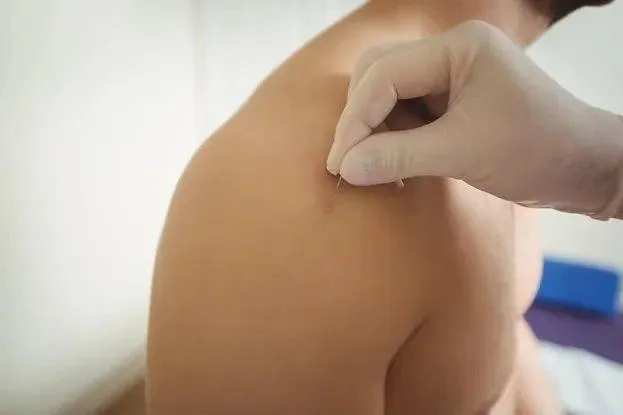
Why Dry Needling Gets Results When Other Treatments Haven't
You've tried massage. You stretched for weeks. Maybe you even saw another PT who worked on the area and gave you exercises. Things felt better for a day or two, then the pain came back — same spot, same pattern, same frustration.
That cycle has a reason. It's usually not that the treatment failed — it's that the muscular component of the problem was never directly addressed. That's where dry needling works.
What Dry Needling Actually Is
Dry needling is a technique in which a thin, solid filament needle — the same type used in acupuncture — is inserted directly into a myofascial trigger point. A trigger point is a hyperirritable spot within a taut band of muscle that is painful when compressed and often refers pain or other sensations to distant locations. The "dry" refers to the fact that nothing is injected. The needle itself is the treatment.
It is called trigger point dry needling (TrP-DN) to distinguish it from acupuncture, with which it shares a tool but nothing else. Dry needling is rooted in neurophysiology and biomechanics. It targets specific anatomical structures — dysfunctional motor endplates, taut muscle bands, contraction knots — based on clinical examination findings rather than energy meridians or traditional Chinese medicine principles [1].
Why the Knot Won't Release on Its Own
To understand why dry needling works, you need to understand why the trigger point formed in the first place — and why it persists.
Trigger points don't appear randomly. They are a downstream response to something upstream: a faulty movement pattern, a posture the body has adopted to protect an injured area, chronic stress loading the nervous system beyond what the muscular system can clear. When the nervous system fires more frequently than the musculature can recover from, the motor endplates — the junctions where nerve signals instruct muscle fibers to contract — begin to dysfunction. Excessive acetylcholine, the neurotransmitter that drives contraction, accumulates faster than the enzyme that clears it can keep up. A small zone of muscle fibers locks into sustained contracture. Local blood vessels compress. Oxygen and energy supply drop. Without adequate ATP, the muscle can't complete the normal cycle of contraction and relaxation. The area stays locked, the local biochemical environment becomes acidic and inflamed, and the nervous system registers the whole situation as a persistent threat.
This is the expanded integrated trigger point hypothesis. The trigger point is not just a tight muscle. It is a localized biochemical crisis [2].
A landmark study at the U.S. National Institutes of Health measured this directly, sampling the fluid inside active trigger points in real time using in vivo microdialysis. The researchers found significantly elevated concentrations of bradykinin, substance P, calcitonin gene-related peptide, tumor necrosis factor-alpha, interleukin-1β, serotonin, and norepinephrine — the same chemicals associated with pain sensitization and inflammation — compared to latent trigger points and pain-free controls [3].
Massage, stretching, and foam rolling can reduce surrounding tension and temporarily feel helpful. But they can't reach the endplate zone at the center of the problem with enough precision to interrupt the cycle. The trigger point persists. And if the upstream pattern that created it isn't also addressed — the movement fault, the guarding strategy, the chronic stress load — a new trigger point is liable to form in the same area even after the original is resolved. This is true of every treatment approach, not just needling. Dry needling clears the muscular accumulation; the broader plan addresses what drove it there.
What the Needle Does
When a needle is inserted accurately into a trigger point, several things happen simultaneously.
The motor response. The muscle fibers in the taut band produce a local twitch response (LTR) — a brief, involuntary contraction followed by relaxation. This is a spinal cord reflex: the needle's contact with the electrically hyperactive endplate zone sends an afferent signal up to the spinal cord, which fires an efferent motor command back to the muscle, producing the visible twitch. It is not something the patient controls, and it signals that the needle has engaged the trigger point [4]. The LTR is also mechanically significant — it disrupts the contracted sarcomeres that have been locked in shortened position, allowing them to resume resting length in a way that external pressure cannot reliably accomplish. In the Shah et al. research, biochemical sampling immediately after LTRs were elicited showed that nociceptive substance concentrations in the trigger point environment dropped toward normal levels. The twitch appears to flush or reset the local chemical milieu.
The sensory response. The needle frequently reproduces the patient's familiar pain pattern — the same ache down the arm, the same referral into the head, the same sensation that brought them in. This is diagnostically meaningful: it confirms that the structure being treated is generating the patient's actual symptoms. Sensations during needling can include deep aching, burning, tingling, or pressure, felt locally or at a distance from the needle. These responses reflect the sensory component of trigger point activity and are a sign that the right area has been reached.
The autonomic response. Some patients notice sweating, goosebumps, or a brief flush of warmth during or after needling. These are autonomic responses — the nervous system's involuntary regulatory activity — and indicate that the trigger point had meaningful involvement of the autonomic nervous system, which is consistent with more active or centrally sensitized presentations. They are transient and not cause for concern.
Not all three responses occur in every treatment or in every patient, and benefit does not require all three. But when they are present — particularly when the sensory response reproduces familiar symptoms — it provides strong confirmation that the treatment has found its mark.
There is also a secondary circulatory benefit worth noting. The contracted muscle fibers in a trigger point compress local capillaries, effectively starving the tissue of blood flow. When the contracture releases, perfusion improves. An area that has been in a state of localized ischemia — sometimes for months or years — begins to receive normal blood supply again. Patients sometimes notice a warmth or a sense of release in the area that goes beyond the mechanical relief.
After needling, the nervous system registers a reduction in threat, movement becomes more accessible, and a window opens. That window is the opportunity. The hands-on work opens the door. What happens in that window — the loading, the movement, the home program — is what makes the change stick.
Who Responds Well
Dry needling tends to be particularly effective for people who recognize any of these patterns:
Prior treatment that didn't hold. If you saw a PT or chiropractor and felt better during or after the session but kept returning to the same baseline, the original trigger point likely wasn't reached directly. Dry needling works at a different depth and specificity than surface manual therapy.
Pain with a clear referred component. Trigger points routinely send pain to locations far from where the problem actually lives. Shoulder pain that originates in the neck. Knee pain driven by hip muscle dysfunction. Headaches sourced from the suboccipital muscles. If you've been chasing the symptom without success, the trigger point may be elsewhere.
Post-injury or post-surgical areas that never fully recovered. Muscles that have been guarded or unloaded for months develop secondary trigger points as neighboring structures compensate. These become self-sustaining even after the original injury heals.
Athletes with persistent performance limitations. Latent trigger points — ones that don't produce spontaneous pain — have been shown to alter muscle activation timing and reduce movement efficiency. Research on shoulder muscles found that subjects with latent trigger points had measurably abnormal activation patterns compared to pain-free controls, and that dry needling restored normal patterns immediately [1]. The problem doesn't have to hurt to cost you something.
What to Expect
The needle itself is extremely fine — between 0.16 and 0.30 mm in diameter, far thinner than any medical injection needle. Insertion is often barely perceptible. The twitch response, when it occurs, may feel like a brief deep cramp or charlie horse lasting one to two seconds. The sensory response — aching, burning, or a familiar referred sensation — typically lasts only as long as the needle is in place or moments after it's removed. The autonomic response, if it occurs, is brief.
Post-treatment soreness in the area is common for 24–48 hours, similar to how muscle responds after hard training. This is normal and is part of the repair process — dry needling intentionally creates a controlled pro-inflammatory micro-stimulus that drives tissue remodeling. For that reason, ice and anti-inflammatory medications are best avoided in the day or two following treatment, as both would work against the inflammatory repair response the needling initiated. Gentle movement and heat are appropriate. The full benefit of a session usually becomes clear two to three days afterward, once the initial soreness has settled.
Dry needling at Latitude Physio is never used on its own. It's one input; movement is the other — and together they do something neither accomplishes alone. Needling clears what's stuck. Movement teaches the nervous system a new pattern in the space that opens up. If you've been stuck in a loop, it's often because you've been repeating the same single input — more stretching, more massage, more rest — instead of pairing a different kind of input with a different kind of loading. That combination is usually what's been missing.
A Note on Scope
In Texas, dry needling falls within the scope of physical therapy practice. The Texas Board of Physical Therapy Examiners has affirmed that PT-performed dry needling is a legitimate intervention when the clinician has appropriate training and competency. You do not need a referral to a separate provider, and you do not need to see an acupuncturist. Your PT can evaluate, identify the trigger points contributing to your symptoms, and treat them in the same session.
The Reason Prior PT Might Not Have Included It
Many PTs — particularly those working primarily in the insurance-based model — don't routinely perform dry needling. The training is postgraduate and specialized. At Latitude Physio, it is a core part of the clinical toolkit, not an occasional add-on. If you've done PT before and the results didn't hold, this difference in approach may be part of the reason.
If you're dealing with a pattern that keeps coming back despite your best efforts, there's usually something that hasn't been directly addressed yet — often it's not one missing thing, but a missing combination.
Needling can open the door. This is how you start walking through it.
References
Dommerholt J, Mayoral del Moral O, Gröbli C. Trigger point dry needling. In: Dommerholt J, Huijbregts PA, eds. Myofascial Trigger Points: Pathophysiology and Evidence-Informed Diagnosis and Management. Sudbury, MA: Jones & Bartlett; 2011:159–190.
Gerwin RD, Dommerholt J, Shah JP. An expansion of Simons' integrated hypothesis of trigger point formation. Curr Pain Headache Rep. 2004;8(6):468–475. https://doi.org/10.1007/s11916-004-0069-x
Shah JP, Danoff JV, Desai MJ, et al. Biochemicals associated with pain and inflammation are elevated in sites near to and remote from active myofascial trigger points. Arch Phys Med Rehabil. 2008;89(1):16–23. https://doi.org/10.1016/j.apmr.2007.10.018
Hong C-Z. Lidocaine injection versus dry needling to myofascial trigger point: The importance of the local twitch response. Am J Phys Med Rehabil. 1994;73(4):256–263. https://doi.org/10.1097/00002060-199407000-00006
